
60 sales psychology principles that hold up online, with the studies
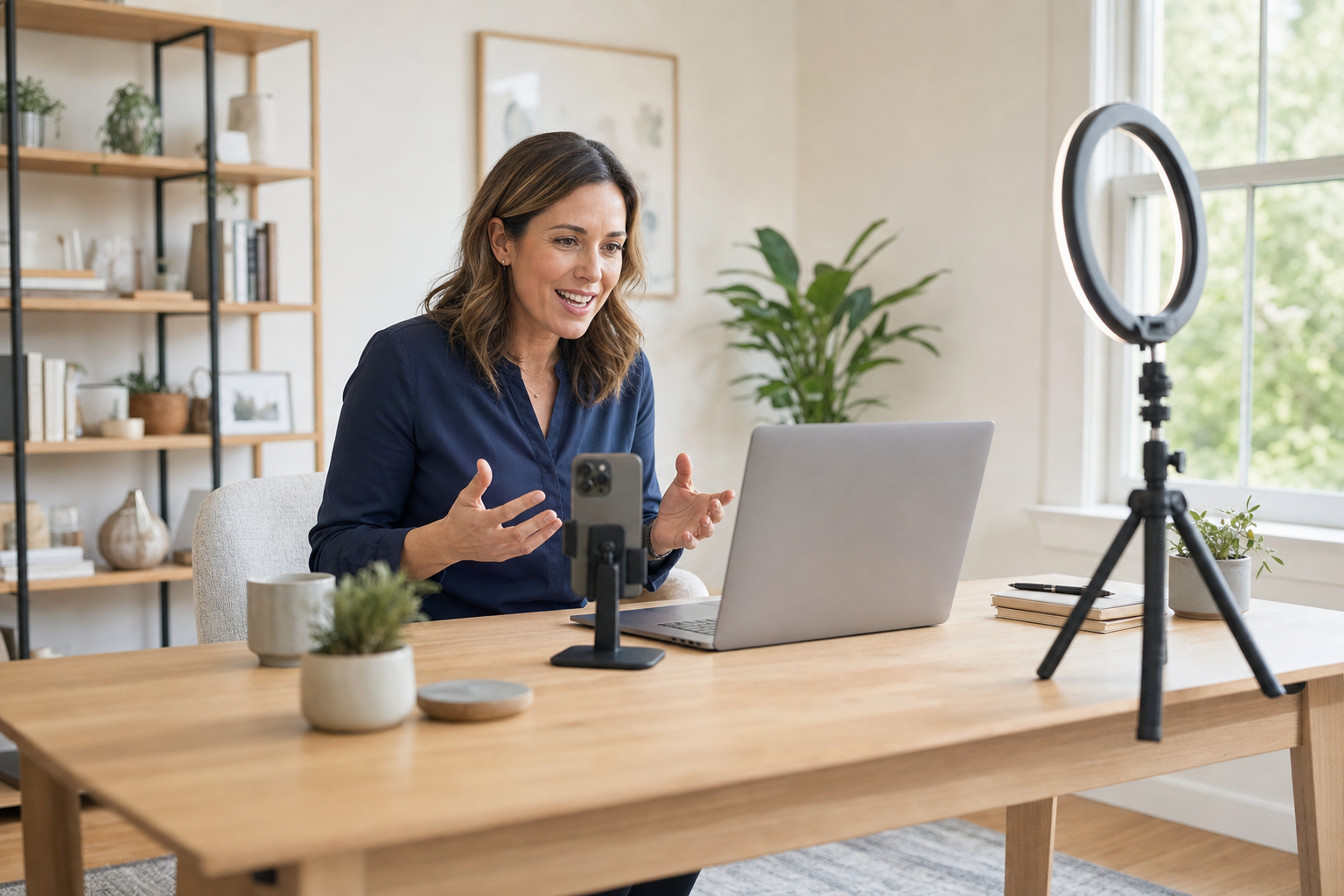
This is for SDRs, founders and SaaS sales teams who sell on a screen: demos over Zoom, recorded pitches, webinars, video in the follow-up.
Every principle below comes with the study that found it. The authors, the year, what they measured and the number they got. Kahneman and Tversky. Cialdini. Samuelson and Zeckhauser. Bailenson on Zoom fatigue. Gong's call data. Where a famous finding has failed to replicate, or got retracted (one did, this month), I say so instead of passing it on.
You'll get 60 principles in 10 groups, and for each one a concrete way to use it in a demo, a sales video or a webinar. The last group covers what changes when the buyer is a face in a box instead of a person across a table.
Your pitch on repeat. You only when it counts. Webinar Flow records your demo once and books prospects into sessions that run like they're live. A real question buzzes your phone; you answer in chat, or pause the recording and go live on camera, and it resumes when you're done. Every answer trains an AI to take that question next time. Most of the 60 principles below get easier once the 90% of your pitch that never changes is already recorded.
A note on how to read the list. Each entry has 4 parts: the principle, the study (who, when, what they measured, the figure), what it means when the buyer is on the other side of a screen, and one thing to do about it in a demo, a video or a webinar. Where I write "replication record: shaky", the original study is famous and the follow-up evidence is weak. Use those with care and don't build a deck on them.
Attention and first impressions
The buyer decides a lot about you before you've said anything useful. These 6 principles cover the first minute, which on a recording is the same first minute for every prospect you'll ever book, so it's worth getting right once.
1. You get judged in a tenth of a second. Willis and Todorov (2006) showed faces for 100 milliseconds and found that judgments of trustworthiness, competence and likeability made that fast correlated highly with judgments made with no time limit. More time mostly added confidence, not accuracy. Online, your first frame is that 100 milliseconds: the thumbnail on the booking page and the opening shot of the recording. Eye level, lit face, looking at the lens, already mid-smile. Re-record the first 5 seconds until it's right; the rest can be rougher. The same goes for the moment you go live from your phone mid-session: check the framing before you tap.
2. The halo effect colours every feature you show. Nisbett and Wilson (1977) had 118 students watch the same instructor being warm or cold, then rate his appearance, mannerisms and accent. Warm viewers found them appealing; cold viewers found the same traits irritating, and most denied their overall impression had anything to do with it. In a demo, the buyer's read on you in minute one becomes their read on your reporting screen in minute 20. Spend the first minute being likeable and specific about them, then show features.
3. Primacy and recency decide what gets remembered. Murdock (1962) mapped the serial position curve in free recall: items at the start and the end of a list are recalled far better than the middle. Put your strongest proof point in the first 2 minutes and your offer in the last 2. The middle is where you put the "how it works" walkthrough, because that's the part they'll re-watch on the replay anyway.
4. Open a gap, then close it. Loewenstein (1994) described curiosity as an information gap: attention locks on when we notice a specific thing we don't know, and the discomfort of not knowing drives us to close it. "There are 3 places a demo loses deals, and 2 of them happen before the screen share" is a gap. Name it in the first 30 seconds, pay it off by the end. If you never pay it off, you've taught them not to trust your hooks.
5. Two minutes on your company, then stop. Gong Labs analysed hundreds of thousands of recorded sales calls and found that a company overview is fine for about 2 minutes, after which there's a sharp drop in win rates (2017, refreshed 2026). Cut the founding story and the logo wall. One sentence on who you help, then into their problem. When the pitch is recorded, this is the easiest edit you'll ever make: it's the same 90 seconds saved on every session.
6. Familiarity breeds liking. Zajonc (1968) showed that repeated exposure to a stimulus, even nonsense words and characters, made people like it more, and later work found it held even when exposure was too brief to notice. Put the same face on the booking page, the reminder email, the recording and the live jump-in. Same person, same background, same name. By the time they see you on camera, you're already familiar, which reads as trustworthy.
Trust and credibility
Trust is decided on two dimensions, in a fixed order, and most pitches answer them backwards. These 6 cover how to earn it without a slide of logos.
7. Warmth gets judged before competence. Fiske, Cuddy and Glick (2007) reviewed the evidence on social perception and found two universal dimensions: we first judge whether someone intends good or ill (warmth), and then whether they can act on it (competence). Credentials in the first 30 seconds answer the second question before the buyer has asked the first. Answer warmth first: "I'm going to show you the 3 things that matter for a team your size, and I'll tell you the 1 thing we don't do."
8. Authority cues work, so borrow them rather than claim them. Milgram (1963) found that 26 of 40 participants (65%) delivered what they believed was the maximum shock because a man in a lab coat told them to. Cialdini's team applied the same principle to a real estate office: having the receptionist mention the agent's credentials before the handover produced 20% more appointments and 15% more signed contracts. Let the booking page and the confirmation email do the introducing. In the recording, someone else says who you are; you never do.
9. Two-sided messages beat one-sided ones, if the negative is small and early. Eisend's (2006) meta-analysis of two-sided advertising found the persuasive effect depends on how much negative information you include, its placement, and whether you volunteered it. Volunteer one real limitation in the first 5 minutes ("we don't do X, and if X is your main need, this session will save you time by ending early"). It buys credibility for every claim that follows. A recorded pitch makes this easier, because the limitation is scripted once and never gets softened on a bad day.
10. Precise numbers signal confidence. Jerez-Fernandez, Angulo and Oppenheimer (2014) found that people read precise numbers as a cue that the speaker is confident and knowledgeable, and they lean on precise estimates more than round ones. "Onboarding takes about a month" loses to "onboarding averaged 27 days across the last 40 accounts". If you've got the number, use the exact one.
11. An expert who admits uncertainty is more persuasive. Karmarkar and Tormala (2010) found that high-expertise sources become more persuasive when they express uncertainty, because it violates expectations and pulls the listener in. Non-experts get the opposite effect. So once you've established you know the product cold, "honestly, I'm not sure this fits your workflow, let me check" from a live jump-in lands harder than a confident answer. The trick is to only be uncertain about the edges, never the core.
12. A small stumble makes a competent presenter more likeable. Aronson, Willerman and Floyd (1966) had people listen to a quiz contestant who got 92% right or 30% right, with or without spilling coffee on himself. The competent contestant who spilled the coffee was rated most attractive; the average one who spilled it was rated lower. For the recorded pitch: if you clearly know your stuff, leave the small flub in. If the session already feels shaky, cut it.
Social proof
People look sideways when they're unsure, and a B2B buyer is unsure most of the time. These 6 principles cover doing that honestly, and the one way social proof backfires in a demo.
13. A unanimous room bends judgment, and one dissenter breaks the spell. Asch (1956) found that about 74% of participants went along with an obviously wrong majority at least once, and roughly a third of all critical responses conformed. A single confederate giving the right answer dropped conformity to around 5%. Two lessons for a webinar. First, a visible room of real attendees and real questions is worth more than a testimonial slide. Second, one unanswered skeptical question in chat is the dissenter; answer it in the open, fast.
14. Proof from people like them beats proof from everyone. Goldstein, Cialdini and Griskevicius (2008) tested towel-reuse signs in hotel rooms. "Most guests reuse their towels" beat the standard environmental message, and "most guests who stayed in this room reused their towels" beat that. Cialdini reports the lifts as 26% and 33% over the 35% baseline. "Sales teams of 8 to 15 reps selling to mid-market" is the room. "10,000 customers" is the hotel.
15. Generic social proof in a demo lowers close rates. Gong analysed 3 million recorded web demos and found sellers who used social proof techniques during the call closed 22% less often, and 47% less often on early-stage calls (2019, refreshed 2026). Their read: name-dropping reads as a script, and it pulls the conversation off the buyer's problem. Keep the customer story for the moment it answers a specific objection, and make it about one company that looks like theirs.
16. Five reviews move the needle; a perfect score hurts. Northwestern's Spiegel Research Center (2017) found products with 5 reviews were 270% more likely to be bought than products with none, rising to 380% for higher-priced items, and that purchase likelihood peaked at 4.0 to 4.7 stars, then fell as ratings approached 5.0. Put your real G2 score on the booking page, 4.6 and all. A flawless 5.0 reads as staged.
17. The first response shapes everything that follows. Muchnik, Aral and Taylor (2013) ran a randomised experiment on a social news site: an initial positive vote raised the chance of later positive ratings by 32% and lifted final scores by 25% on average. Negative first votes got corrected by the crowd; positive ones snowballed. In a webinar, the first question in chat sets the tone for every question after it. Seeded prompts and polls exist for exactly this: a real, useful first question so the room never sits empty. Never fake attendees to do it. The seeded prompt should be a question a real buyer asked last week, with your real answer, and it should be obvious that later questions get a human.
18. The demo is the proof. TrustRadius's 2025 report found the three resources B2B tech buyers consult most are product demos, their own prior experience, and user reviews. Two of those three are things you don't control. The one you do control is the demo, and the biggest lever on it is whether the buyer can get one without booking a rep's calendar. Make it bookable, day or night, and let it run like it's live.

Scarcity and urgency, used honestly
Scarcity works. So does the backlash when it's fake, and the backlash now has a regulator behind it. These 5 principles keep you on the right side of both.
19. Scarcity raises perceived value, and lost abundance raises it most. Worchel, Lee and Adewole (1975) gave people a jar of 10 cookies or 2 and asked them to rate the cookies. The 2-cookie jar scored higher, and a jar that started at 10 and dropped to 2 in front of them scored highest of all. If your onboarding team really does take 6 new accounts a month, show the live count and let it fall. The number has to be real, and it has to be visible. If you can't show it, don't claim it.
20. Limited quantity beats limited time. Aggarwal, Jun and Huh (2011) compared the two classic scarcity messages and found limited-quantity messages ("only 20 available") were more effective than limited-time messages ("offer ends Friday"), because quantity implies other buyers are competing for the same thing. "5 implementation slots left this quarter" is a stronger offer card than "pricing valid until the 30th".
21. A restriction makes the deal look better. Inman, Peter and Raghubir (1997) ran 4 studies and found purchase limits, time limits and preconditions all act as signals that a deal is worth having, and lift purchase intent through that perceived value. An eligibility condition on your webinar offer ("for teams under 25 reps, booked in this session") makes it read as worth more than the same offer open to anyone.
22. Fake countdowns are now a regulator's example, so make deadlines real. The FTC's 2022 dark patterns report lists countdown timers that imply a deadline when the offer isn't time-limited as a deceptive practice. And a caution on the research side: the go-to citation for "deadlines work", Ariely and Wertenbroch's 2002 paper on self-imposed deadlines, was retracted in September 2026. Stop citing it. A timed offer card in a recorded session should expire because something real expires: the slot, the price, the cohort.
23. Push and people push back. Brehm's theory of psychological reactance holds that when someone feels their freedom to choose is threatened, they act to restore it, often by doing the opposite. Fitzsimons and Lehmann (2004) showed the sales version: unsolicited recommendations that contradict a buyer's initial lean trigger reactance and contrary choices. Before you recommend a plan, find out which way they lean. In a recorded session that's a poll at minute 15; in a live jump-in it's one question before the answer.
Loss aversion and the status quo
The buyer's real competitor is doing nothing, and doing nothing has a psychology of its own. These 6 principles explain why, and how to shift the reference point so the status quo stops looking safe.
24. Losses hurt roughly twice as much as gains feel good. Kahneman and Tversky's prospect theory (1979) showed that people evaluate outcomes as gains or losses from a reference point, and the value function is steeper for losses. "You'll gain 6 hours a week" is weaker than "you're losing 6 hours a week, every week, until this changes". Put the current monthly cost of the problem on screen before you put a price on the fix.
25. Owning something raises its price in your head. Kahneman, Knetsch and Thaler (1990) handed Cornell students $6 coffee mugs and ran markets in them. Sellers demanded about twice what buyers would pay, and far fewer mugs traded than theory predicted. A trial account with their own data loaded, their own pipeline named, their own reps invited, is a mug in their hand. Get them owning something during the session, even a workspace with their logo on it. The session's poll answers can seed it: their team size, their tool, their first use case, already filled in when the trial email lands.
26. The status quo wins by default. Samuelson and Zeckhauser (1988) found that an option became much more popular the moment it was labelled the current position, and the bias grew as more alternatives were added. Two moves. Show fewer options (see principle 40). And make the status quo cost something visible, so "keep what we have" stops feeling like the safe choice.
27. Whatever is pre-selected wins. Johnson and Goldstein (2003) compared organ donation rates in opt-in and opt-out countries and found effective consent rates near 99% under opt-out defaults versus a fraction of that under opt-in, with the same pattern in their online experiment. Default the plan you recommend. Default the next step ("your onboarding call is pencilled for Thursday, reply to move it"). Default the replay to send.
28. Sunk costs keep buyers loyal to the tool they hate. Arkes and Blumer (1985) sold theatre season tickets at $15, $13 and $8 to randomly assigned buyers. The full-price group attended the most plays; having paid more, they felt more obliged to use them. Your buyer has 18 months and a lot of embarrassment sunk into the incumbent. Don't attack it. Frame the switch as keeping what works and replacing the one piece that's broken, and their sunk cost stops being your enemy.
29. "No decision" is the biggest loss column, and it isn't about you. Dixon and McKenna (2022) studied 2.5 million recorded sales conversations and found 40% to 60% of deals are lost to customers who say they intend to buy and then never act. Their finding: fear of making a mistake beats preference for the status quo. Gong's data points the same way: language about opt-outs, guarantees and SLAs lifts win rates by 32% on average. Reduce the risk of saying yes, not the risk of saying no.
Reciprocity and commitment
Small gifts and small yeses compound over a 40-minute session. These 6 cover the mechanics, including one famous study that only works for small asks.
30. A favour first makes the ask land, whether or not they like you. Regan (1971) had a confederate buy some participants a Coke during an experiment, then ask everyone to buy raffle tickets. Those who'd received the drink bought more tickets, and the favour mattered more than how much they liked him. Give the useful thing inside the session: a teardown of their current flow, a template, a number they didn't have. And the biggest favour in a recorded session is the presenter pausing the recording to answer you in person. That's your time, given unasked, and it gets repaid.
31. Small, personal and unexpected beats big and standard. Strohmetz, Rind, Fisher and Lynn (2002) tested mints with the restaurant bill. Per Cialdini's summary, one mint lifted tips 3%, two mints 14%, and one mint plus a personal "for you, because you were great" 23% (study record). The webinar version is the second answer: after you've answered the question, come back with "one more thing, specifically for your setup". It's the personalised mint.
32. A small yes makes the big yes twice as likely. Freedman and Fraser (1966) asked homeowners to put a large "drive carefully" sign on their lawn. 76% agreed if they'd first agreed to a small sticker; 17% agreed cold. Booking the session is the first small yes. The poll at minute 5 is the second. By the time the offer card fires, the buyer has said yes to you 3 times.
33. A big no makes the smaller yes three times as likely. Cialdini and colleagues (1975) asked students to chaperone juvenile offenders on a zoo trip. Asked cold, 17% agreed; asked after first refusing a 2-year volunteering commitment, 50% agreed. Ask for the 5-rep pilot. When they wince, ask for the 1-rep trial. The concession is what makes the second ask feel like a deal.
34. Active commitments stick; passive ones evaporate. Cioffi and her co-author (1996) compared people who actively chose to volunteer with people who were enrolled by default and had to opt out. The active choosers were more likely to follow through and saw the commitment as more self-defining. Don't send the trial to everyone. Make them click "yes, send me the trial" in a poll during the session. The click is the commitment. It also tells you who to call first, because the people who clicked have already decided something.
35. "Because" works, but only for small asks. Langer, Blank and Chanowitz (1978) asked to cut a copy-machine queue. For a 5-page request, 60% complied with no reason, 94% with a real reason, and 93% with the empty reason "because I have to make copies". The part the marketing summaries skip: at 20 pages, the empty reason did nothing (about 24%, same as no reason) and only the real reason helped (about 42%). For a poll click, any reason. For a purchase, a real one, and the real one is usually a number from principle 24.
Framing and anchoring on price
Price is never seen in isolation. It's seen next to whatever number came before it, whatever plan sits beside it, and whatever frame you chose for the problem. These 8 principles are about what you put next to it, and when.
36. The first number sets the range. Tversky and Kahneman (1974) described anchoring as adjustment from an initial value that is usually insufficient, even when the anchor is random. Ariely, Loewenstein and Prelec (2003) showed the extreme case: the last two digits of a social security number shifted what people would pay for wine and keyboards. The first number in your pitch should be the cost of the problem, or the price of the enterprise tier. Never let the first number be your cheapest plan.
37. A decoy makes the plan you want look obvious. Huber, Payne and Puto (1982) showed that adding an option that's clearly worse than one plan but not the other raises the share of the plan it's worse than. A $79 plan with 3 pitches next to a $99 plan with 3 pitches and AI included makes the $99 plan the only sane choice. The decoy has to be a real product someone could buy, or it's a dark pattern.
38. The middle option gets chosen, especially when the buyer has to justify it. Simonson (1989) found that a brand gains share when it becomes the compromise option in a set, and the effect strengthens when people expect to explain their choice to others. B2B buyers always have to explain their choice to someone. Put the plan you want them on in the middle, and give them the one sentence they'll use in the budget meeting.
39. The same outcome framed as a loss changes the decision. Tversky and Kahneman (1981) showed reversals of preference when identical choices were framed as lives saved versus lives lost. "Reps spend 40% of their week on non-selling work" and "reps sell 60% of the week" are the same fact. The first one sells a productivity tool. Pick the frame on purpose, and use it consistently across the booking page, the deck and the follow-up.
40. Fewer options convert, but the effect is smaller than the jam story suggests. Iyengar and Lepper (2000) found shoppers were more likely to buy when offered 6 jams than 24, and reported higher satisfaction. Replication record: shaky. Scheibehenne, Greifeneder and Todd's (2010) meta-analysis of 50 experiments and 5,036 participants found a mean effect size of virtually zero, with big variation between studies. So: 3 plans, not 7, is still sound advice, because it costs nothing and helps when it helps. Just don't promise your boss it'll triple conversion.
41. Pennies a day beats a lump sum. Gourville (1998) showed that framing a cost as a small daily amount makes people compare it to small everyday expenses, while the aggregate frame makes them compare it to large, rare ones. "$2.60 a day per rep" and "$79 a month" are the same price. Say the daily one on the offer card; put the monthly one on the invoice.
42. Free isn't just cheap. It's a different category. Shampanier, Mazar and Ariely (2007) found that cutting a price to zero produces a jump in demand far beyond what the small price drop should cause; people treat free as having no downside. A free tier or a free first session removes the cost-benefit calculation entirely. Use it to get them owning something (principle 25), then let the endowment effect do the selling.
43. Price late, and let the buyer bring it up. Gong's analysis of 67,149 demos found winning demos discussed pricing between the 38 and 46 minute mark, and losing demos spent 8% more time on it (2017, refreshed 2026). Their separate call data shows 3 to 4 pricing questions from the buyer correlate with the highest win rates, and that the phrases "list price", "typical price" and "standard price" stretch the sales cycle by 19%. In a recorded session, that's your timed offer card: after the value, never before, and worded as one price.
Questions and dialogue
The buyer talking is the strongest signal the sale is alive. These 6 come almost entirely from call recordings, which is the one place sales psychology gets measured at scale instead of theorised.
44. Talk less than you think, but not as little as the old ratio said. Gong's 2016 "golden ratio" of 43% talking to 57% listening got a 2025 refresh across 326,000 calls: won deals had the rep talking 57% of the time, lost deals 62%. The gap matters more than the number. In a demo, Gong found no closed-won deal contained more than 76 seconds of uninterrupted pitching. For a recorded pitch, that means a poll, a question or a pause at least every 75 seconds, or the buyer checks their email.
45. Ask 11 to 14 questions, spread out, about their business. Across 519,000 B2B calls, Gong found success peaked at 11 to 14 targeted questions per discovery call, with top reps pacing them through the call instead of front-loading a checklist. The 2025 refresh moved the sweet spot to 15 to 16 questions on won deals versus about 20 on lost ones. Too many reads as an interrogation. In a recorded session, the questions become polls and seeded prompts, and the count still applies.
46. Asking questions makes people like you, and talking about themselves is a reward. Huang, Yeomans, Brooks, Minson and Gino (2017) found across 3 studies that people who ask more questions, especially follow-ups, are better liked, and that askers don't anticipate the effect. Tamir and Mitchell (2012) found that self-disclosure activates the same reward circuitry as food and money, and people will give up cash to do it. The follow-up question is the tell. "Why did that break?" beats "got it, next slide".
47. Asking about intent changes behaviour. Morwitz, Johnson and Schmittlein (1993) found that simply asking consumers whether they intended to buy raised subsequent purchase rates, while repeated asking polarised low-intent buyers further away. One poll near the end of a session ("which of these would you roll out first?") is the mere-measurement effect in a box. Ask it once. The answers also tell the presenter which question is likely to come in live, so the phone alert isn't a surprise.
48. "We" beats "I". In Gong's analysis of cold calls, the ratio of "we" to "I" was 35% higher on successful calls, and "our" to "my" was 55% higher (2018, refreshed 2026). Collaborative language frames the call as a shared project. Script the recorded pitch in "we": "here's what we'd set up first", "our next step". It costs nothing and it's the easiest line-edit in this whole post.
49. Answer an objection with a question, then a pause. Gong's objection-handling data shows top reps respond to objections with a clarifying question 54.3% of the time versus 31% for average reps, pause 5 times longer, and slow down to 176 words a minute against 188. In a live jump-in that's the whole playbook: ask what's behind the objection, wait, answer slower than feels natural. There are 75 worked answers in our sales objections post.

Memory and story
The buyer remembers a fraction of what you said, and decides on that fraction 3 days later in a meeting you're not in. These 5 are about which fraction, and one storytelling study you should stop quoting.
50. Stories are remembered 7 times better than lists. Bower and Clark (1969) had people learn 12 lists of 10 words either by rehearsal or by weaving them into a story. Median recall was 93% for the story group and 13% for the controls. Six features on a slide is a list. One customer, one Tuesday, one broken pipeline and what happened next is a story, and it carries the same 6 features to the budget meeting.
51. When a story works, the listener's brain follows the speaker's. Stephens, Silbert and Hasson (2010) scanned speakers and listeners during natural storytelling and found the listener's brain activity coupled to the speaker's, with the coupling vanishing when communication failed. The more the listener anticipated, the better they understood. Tell the demo as a sequence with a next-thing to anticipate ("watch what happens when the second rep logs in") instead of a tour of tabs.
52. The oxytocin story is popular, and the trust evidence behind it hasn't held up. Zak (2015) reported that participants given oxytocin donated 56% more to charity, and that character-driven stories with rising tension were the ones that moved people. Replication record: shaky. Nave, Camerer and McCullough (2015) reviewed the oxytocin and trust literature and concluded that the intranasal oxytocin findings had not replicated well and the cumulative evidence does not show human trust reliably tied to oxytocin. Tell stories because they're remembered (principle 50), not because of a hormone.
53. They remember the peak and the end, not the average. Redelmeier and Kahneman (1996) tracked real-time pain in 154 colonoscopy and 133 lithotripsy patients and found remembered pain tracked the worst moment and the final 3 minutes, and long procedures weren't remembered as worse. Kahneman's earlier cold-water study found the same shape: people chose to repeat a longer painful trial because it ended slightly better. Engineer one peak (the moment the buyer's own problem gets solved on screen) and a strong last 2 minutes. And since Murre and Dros (2015) replicated Ebbinghaus and found forgetting jumps at the 24-hour mark, send the replay the same day, with the peak moment timestamped in the email.
54. What they generate, they keep. Slamecka and Graf (1978) named the generation effect: information people produce themselves is remembered better than the same information read. Livestorm's 2026 benchmark across 33,786 sessions found the average webinar gets 20.4 questions and 2.77 polls, with attendees watching 26 minutes of a 68-minute session. Every poll is a generation event. "Type the number of demos your team ran last week" makes the buyer produce the figure you're about to work with, and they'll remember it.
What changes on a screen
Selling to a face in a box changes the physics: fatigue, sound, lag and response time all get a vote. These 6 are about the box.
55. Video calls are tiring for 4 specific reasons, so don't make the buyer sit through 45 minutes of you. Bailenson (2021) argued that Zoom fatigue comes from excessive close-up eye gaze, constant self-view, reduced mobility, and the extra cognitive load of exaggerated nonverbal signalling. Wistia's data across 13 million videos shows an 11% drop in engagement once a video crosses 30 minutes. A recorded pitch with screen-share for the walkthrough and your face only for the open, the close and the live jump-ins is easier to sit through than a live talking head for 45 minutes.
56. Easy to process reads as true. Reber, Schwarz and Winkielman (2004) showed that the more fluently something is processed, the more positively it's judged, and Alter and Oppenheimer's (2009) review found that fluent stimuli, whether clearer, simpler or more familiar, are judged more true. Clean slides, a plain font, one idea per screen. And a fast, clear answer to a question feels truer than a slow, hedged one, which is the case for an AI that answers the repeat questions instantly and in plain words, from your own past answers.
57. Bad audio makes you sound less smart. Newman and Schwarz (2018) played the same conference talks and radio interviews in high or low audio quality. With identical content, people rated the research as less important and the researcher as less intelligent and less likeable when the sound was worse. A $100 microphone is the highest-return purchase in your sales stack. For the live jump-in from a phone, that means wired earbuds and a quiet room, every time.
58. Lag gets blamed on you, not the connection. Schoenenberg, Raake and Koeppe (2014) found that transmission delay made conversation partners seem less attentive, less extraverted and less conscientious, and people didn't attribute it to the technology. The same misattribution applies to response time in chat. A question that sits unanswered for 4 minutes makes the presenter look absent. Push the question to the presenter's phone, and let the AI take the ones it has seen before, so the gap is seconds. When the presenter does pause the recording and appear, the wait itself becomes the signal: they stopped everything for you.
59. Camera on, both sides. Gong's deal data shows win rates 94% higher when the seller has video on, 96% higher when the buyer does, and deals 127% more likely to close when video is used at all. The recorded pitch has your camera on by design. For the buyer's side, the ask is smaller than a full call: "turn your camera on for the 5 minutes I'm live" is a yes people give.
60. Speed of response is the biggest lever you haven't pulled. Oldroyd's 2007 study of 15,000 web leads and 100,000 call attempts across 6 companies found the odds of qualifying a lead drop 21 times between a 5-minute and a 30-minute response, and the odds of making contact drop 100 times. The 2011 Harvard Business Review audit that followed found firms responding within an hour were nearly 7 times as likely to qualify the lead. Every question in a webinar is a lead raising its hand. The presenter's phone buzzing the second it's asked is that 5-minute window, kept.
Put the psychology on repeat
Sixty principles is too many to run live at 4pm on a Thursday, on the 12th demo of the week. The honest fix is to stop delivering the identical 90% live.
Record the pitch once with principles 1 to 12 in the first 2 minutes, the story from principle 50 in the middle, and the offer card from principles 41 to 43 at minute 40. Seed the prompts and polls that make principles 17, 34 and 54 fire on their own. Then be on your phone for the questions that need a human, and let the AI answer the ones it has already seen.
Start free with Webinar Flow and run your next demo with the psychology built in.
If you want the presentation side of this, the 100 sales presentation tips covers structure and delivery, the 50 SaaS demo rules covers the demo itself, and the 100 sales video tips covers the recording.