
The Complete Webinar Marketing Strategy for B2B Businesses
By Ian Naylor ·
Drafted with AI assistance, then fact-checked and edited by Ian Naylor before publishing.
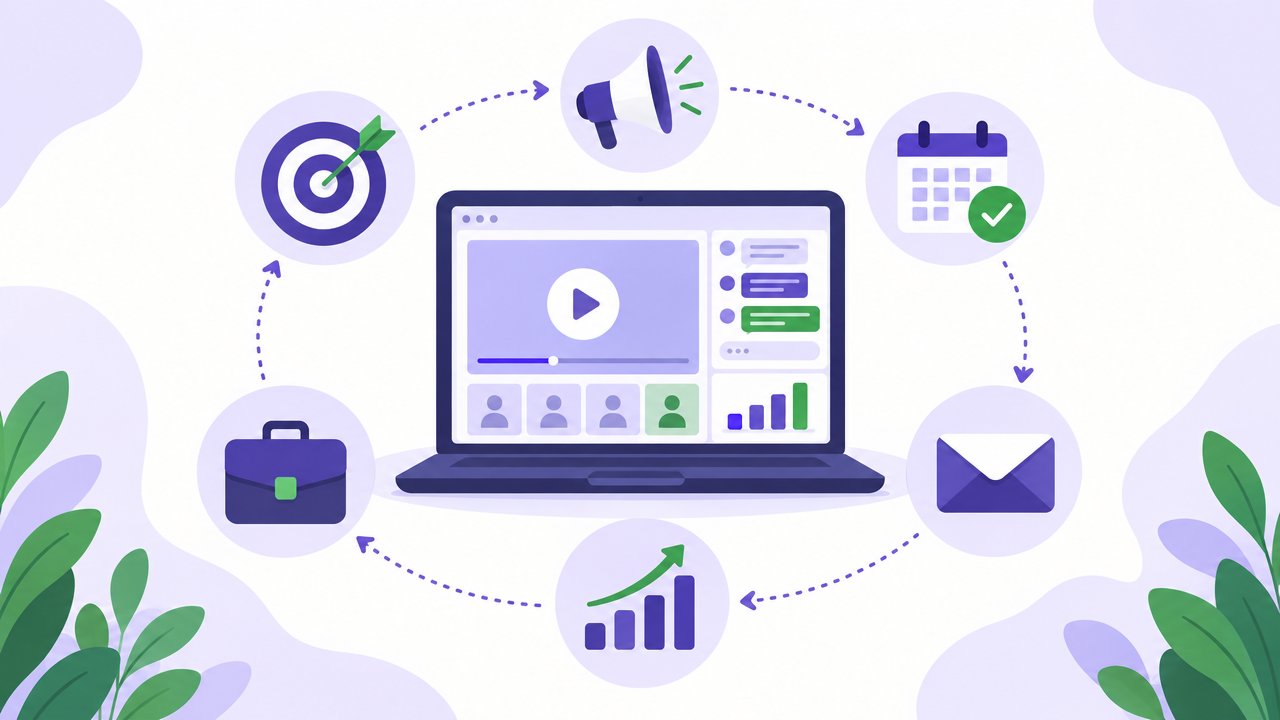
A B2B webinar marketing strategy is a plan for using webinars to move buyers towards a sale: who each webinar is for, what it should teach, how people find it, what you want them to do next, and how you will know it worked. The strongest strategies treat webinars as a repeatable sales channel rather than a one-off event. They pick a narrow audience, solve one real problem per session, promote through the channels that audience already uses, make one clear offer, follow up within hours, and judge success on pipeline rather than registrations.
Most B2B teams already know how to run a webinar. Where they struggle is the strategy around it: why this topic, why this audience, what happens afterwards, and whether any of it led to revenue. This guide works through each decision in order, from goals to measurement, and finishes with a 90-day plan you can adapt.
If you want the mechanics of a single session's journey, from invitation to follow-up, our guide on how to build a webinar funnel goes deeper on each stage. This article sits one level above that: the strategy that decides which funnels you build and why.
Why webinars work for B2B buyers
B2B purchases tend to involve several people, longer research and real risk for whoever signs off. Webinars suit that kind of buying for a few practical reasons:
- They let buyers research without a sales call. Many buyers would rather watch a session than book a meeting early on. A webinar gives them a low-pressure way to see how you think and how your product works.
- They show, not just tell. A recorded walkthrough or live demonstration answers questions that a landing page cannot, especially for software.
- They create a reason to talk. A question asked in the chat, or a poll answer, is a signal of intent you rarely get from a blog visit.
- They can be shared internally. A champion can send a replay to colleagues who were not there, which helps when several people need to agree.
- They are reusable. A good session can be clipped, written up and run again, so the work keeps paying back.
None of this happens automatically. A webinar without a strategy behind it is just a video with a registration form.
Step 1: Decide what the webinar programme is for
Start with the business goal, not the topic. Each webinar should have one main job, and different jobs need different formats and success measures.
| Goal | Typical format | What success looks like |
|---|---|---|
| Create demand among people who do not know you yet | Educational session on a problem your audience has | New contacts from your target accounts, questions asked, follow-on content consumed |
| Convert interested prospects | Product demo or "how it works" session | Demo bookings, trials started, sales conversations opened |
| Speed up deals already in progress | Deep-dive on a feature, integration or use case | Deals that move stage after an attendee watched |
| Onboard and retain customers | Training and best-practice sessions | Adoption of key features, fewer support tickets, renewals |
| Expand existing accounts | Sessions on advanced use or new products | Upgrade and expansion conversations |
Pick one primary goal for each series. Trying to educate cold audiences and close warm ones in the same hour usually does neither well.
Step 2: Define the audience narrowly
"B2B decision makers" is not an audience. A useful audience definition names:
- The role (for example, heads of sales at SaaS companies, or operations managers in logistics).
- The company type and size you can actually serve.
- The problem they are trying to solve right now, in their words.
- What they already know, so you pitch the session at the right level.
- What would make them act after watching.
Write this down for each series. It will guide the topic, title, promotion channels and offer. If your sales team keeps a list of target accounts, align the webinar audience with it so marketing and sales are chasing the same people.
Step 3: Choose topics buyers actually search for and ask about
The best B2B webinar topics come from real buyer questions, not from what you want to announce. Good sources include:
- Sales calls and demos. The questions prospects ask every week are your best topics. If a salesperson answers the same thing five times a month, it should be a webinar.
- Lost deals. Objections that cost you deals point to sessions that tackle those concerns head on. Our list of sales objections and how to answer them is a useful prompt.
- Support tickets and onboarding calls. These reveal what customers find hard, which makes strong education and retention content.
- Search data. Keyword tools show what your audience types into search engines. A topic people search for is easier to promote and gives the replay a longer life.
- Your own expertise. A specific point of view, a framework you use with clients or a process you have refined is harder to copy than a generic overview.
A simple test: could a prospect use what they learn even if they never buy from you? If yes, the topic is probably useful enough to attract the right people.
Step 4: Pick the right format: live, evergreen or both
This is one of the biggest strategic choices, and it shapes your workload and reach.
Live webinars suit launches, announcements, panels with guests and sessions where the live energy matters. They need a host's time for every session, and anyone who cannot attend at that hour only gets the replay.
Evergreen (automated) webinars play a recorded presentation on a schedule, such as several times a day or just in time for whoever registers. They suit content that does not change week to week, such as a product overview, a core demo or a flagship educational session. Once set up, they keep generating registrations and conversations without a host running each one.
Many B2B teams end up with a mix: a small number of live events for reach and freshness, and one or two evergreen sessions that act as an always-open front door for prospects. Our comparison of evergreen and live webinars and the complete guide to evergreen webinars cover the trade-offs in detail.
A common path is to run a topic live first, learn which questions come up, tighten the content, then turn the best version into an evergreen session.
Step 5: Build content that teaches and leads somewhere
A strong B2B webinar is useful in its own right and still points clearly to a next step. A structure that works for most sessions:
- Open with the problem and the promise. In the first couple of minutes, say who the session is for and what they will be able to do by the end.
- Teach the core idea. Give the framework, method or explanation that solves part of the problem.
- Show it working. Use a walkthrough, worked example or demonstration. For software, this is where the product appears naturally.
- Handle the obvious objections. Address cost, effort, switching and risk before people have to ask.
- Make one clear offer. A trial, a demo booking, an assessment or a resource, but only one main call to action.
- Take questions. Questions are some of the best buying signals you will get.
Keep it focused. A tight session that solves one problem is more useful than an hour that touches ten. Our webinar script guide has timings and templates, and the SaaS demo rules help if your webinar is mainly a product demo.
Step 6: Promote the webinar where your buyers already are
Promotion is where many B2B webinars fall short. The aim is not the biggest possible audience, it is the right people from the right accounts. Channels to consider:
- Your own website. Put the next session or the on-demand version on relevant pages: the homepage, pricing, product pages and related blog posts. An embedded booking widget means visitors can register without leaving the page.
- Email to your list. Segment by role or interest rather than sending the same invitation to everyone.
- Sales outreach. Give your sales team a short, personal invitation they can send to target accounts. An invite to a useful session is an easier ask than a cold meeting request.
- Email signatures and calendar links. Every email your team sends can carry a link to the next session or the on-demand replay.
- LinkedIn and other social channels. Personal posts from the speakers often reach further than company page posts. Short clips from previous sessions show people what to expect.
- Partners and guests. A co-hosted session with a partner or industry expert puts you in front of their audience too.
- Communities and newsletters. Niche communities and newsletters your buyers read can work well, provided the session genuinely helps their members.
- Paid promotion. Paid social or search can work for evergreen sessions that are always open, because the landing page keeps converting long after a single date has passed.
For a long list of tactics to get registrants to actually turn up, see 60 ways to lift your webinar show-up rate.
Step 7: Make the registration page do its job
The registration page should answer three questions quickly: what will I learn, is it for me, and when can I watch? Keep it simple:
- A specific, benefit-led headline.
- Three or four bullet points on what attendees will take away.
- Who the session is for (and, ideally, who it is not for).
- Clear session times, or an on-demand option.
- A short form. Ask only for what you will actually use; you can learn more from behaviour during the session.
If you run evergreen sessions, offering times soon after someone registers usually beats asking them to wait days for the next slot.
Step 8: Run sessions that create sales conversations
In B2B, the value of a webinar often shows up in the conversations it starts. Design for that:
- Use polls to qualify. A question such as "Where are you with this today?" tells you who is researching and who is ready to act.
- Encourage questions throughout. Make it easy to ask in the chat and say early on that questions are welcome.
- Answer quickly. A prospect who asks a buying question and waits a day for an answer may have moved on. Fast answers, whether from a person or from an AI trained on your own material, keep the conversation going.
- Have a way to step in personally. When someone is clearly ready to talk, a real person should be able to join the conversation there and then.
- Time your offer. Show the call to action once you have delivered value, not in the first minute, and repeat it near the end.
Step 9: Follow up within hours, not days
Follow-up turns attention into pipeline. Split your follow-up by what people did:
- Registered but did not attend: send the replay or the next available session, with a reminder of why it is worth their time.
- Attended but did not act: send a short summary, the key resource and the offer again. Refer to the topic they came for.
- Asked a question or answered a poll with high intent: this is a sales conversation. A person should reply personally and quickly.
- Took the offer: confirm, make the next step easy and tell sales what the person watched and asked.
Make sure the webinar data (who attended, how long they watched, what they asked) reaches your CRM or sales team, so follow-up can be specific. Our guide to follow-up tactics after a demo or webinar has many more ideas.
Step 10: Repurpose every webinar
A webinar is a lot of content in one place. Turn each session into:
- Short video clips for social posts and sales emails.
- A blog post or guide built on the session's main points.
- An FAQ page drawn from the questions people asked.
- Slides or a checklist as a downloadable resource.
- An on-demand or evergreen version that keeps running.
Repurposing spreads the effort of each session across many channels and helps people who prefer reading to watching.
Step 11: Measure what matters
Registrations are easy to count but say little about revenue. Track the full chain so you can see where to improve:
| Stage | Metric | What it tells you |
|---|---|---|
| Promotion | Registrations from target accounts | Whether you are reaching the right people, not just more people |
| Registration | Registration page conversion rate | Whether the title and page make the promise clear |
| Attendance | Show-up rate (attended ÷ registered) | Whether reminders and timing work |
| Engagement | Average watch time and drop-off points | Where the content loses people |
| Intent | Questions asked, poll answers, offer clicks | Who is showing buying signals |
| Conversion | Demos booked, trials started, meetings held | Whether the offer and follow-up work |
| Revenue | Pipeline and closed revenue influenced by webinars | Whether the programme pays for itself |
Compare these figures against your own past sessions rather than chasing generic industry averages, since results vary widely by audience, topic and offer. If you want outside reference points, our webinar statistics page collects published benchmarks with their sources.
Common B2B webinar strategy mistakes
- Choosing topics for yourself rather than your buyers. Product announcements rarely attract new prospects on their own.
- Measuring success by registrations alone. A big list of the wrong people is not a win.
- One-off events with no follow-up plan. Most of the value comes after the session.
- Too many calls to action. One clear next step converts better than several competing ones.
- Slow answers to questions. A buying question left unanswered is a lost conversation.
- Letting good sessions disappear. If a session worked live, make it available on demand.
- No link to sales. If sales never sees who attended and what they asked, the webinar cannot influence pipeline.
A 90-day B2B webinar plan
Use this as a starting template and adjust to your team's capacity.
Days 1 to 30: foundations
- Agree the primary goal and the audience for your first series.
- Collect the top ten questions from sales calls and support.
- Choose one topic and write the session using the structure above.
- Build the registration page, reminder emails and follow-up sequence.
- Run the session live once, ideally twice, and record it.
Days 31 to 60: turn it into a channel
- Review the recording: where did people drop off, and what did they ask?
- Tighten the content and re-record the best version.
- Set it up as an evergreen session that runs on a schedule, with scripted polls and an offer at set moments.
- Add the booking link to your website, sales emails and signatures.
- Turn the session into clips, a blog post and an FAQ.
Days 61 to 90: scale and measure
- Add a second topic aimed at a different stage of the buying journey.
- Plan one live event with a partner or guest for reach.
- Report on pipeline from webinar attendees, not just registrations.
- Keep what works, drop what does not, and set the next quarter's topics from real questions.
Where Webinar Flow fits
Webinar Flow is an automated webinar platform built for SaaS sales teams, so it is designed for the evergreen side of a B2B webinar strategy: your best presentation running on a schedule, with a real person one tap away.
- Prospects book from a booking page or an embed on your own site, with daily, weekly or just-in-time sessions and instant replay.
- The room locks to the session clock, and scripted chat, polls and your offer card fire at the moments you set.
- When someone books, asks a question or answers a poll, your phone gets a notification. You can reply in the chat, or go live on camera and then hand back to the recording, which picks up where it stopped.
- On the Growth plan and above, AI answers attendee questions from your own material and learns from the answers you give, with an unanswered-questions inbox for anything it missed.
- Attendance and drop-off analytics show where your session loses people.
Plans start at $49 a month, and every plan begins with a 14-day free trial of the Growth experience with no card needed. See pricing, compare Webinar Flow with other platforms, or read our webinar software guide if you are still weighing up tools.
Frequently asked questions
What is a webinar marketing strategy?
A webinar marketing strategy is a plan for how webinars support your business goals. It covers the audience, the topics, the format (live or evergreen), how sessions are promoted, what attendees are asked to do next, how they are followed up and how results are measured.
Are webinars effective for B2B marketing?
They can be, because they let buyers learn and see a product without committing to a sales call, and they create clear signals of interest such as questions and poll answers. Results depend on choosing topics buyers care about, reaching the right accounts and following up quickly.
How often should a B2B company run webinars?
It depends on your capacity and goals. Many teams find it works better to run fewer, stronger sessions consistently than to chase a high volume. An evergreen session can stay available every day, while live events are kept for launches, guests or new topics.
Should B2B webinars be live or pre-recorded?
Both have a place. Live sessions suit announcements, panels and fresh topics. Pre-recorded, evergreen sessions suit core content such as a product overview or demo, because they run on a schedule and are available when prospects are ready. Many teams combine the two.
How do you promote a B2B webinar?
Use your website, segmented email, personal invitations from sales, speaker posts on LinkedIn, partners and the communities and newsletters your buyers read. For always-on evergreen sessions, embedding a booking widget on relevant pages keeps registrations coming in.
How do you measure the success of a webinar programme?
Look beyond registrations. Track registrations from target accounts, show-up rate, watch time, questions and poll answers, demos or trials started, and the pipeline and revenue influenced by attendees. Compare each session with your own previous results.
What should happen after a B2B webinar?
Follow up within hours, split by behaviour: send no-shows the replay, send attendees a summary and the offer, and have a person reply personally to anyone who asked a buying question. Make sure the sales team sees who attended and what they asked.
The bottom line
A B2B webinar marketing strategy works when every session has a clear job, a narrow audience, a topic buyers genuinely care about and a path to a sales conversation. Start with one strong session, learn from the questions it raises, turn the best version into an always-available evergreen webinar, and judge the programme on pipeline. If you want to see how an automated session with a human one tap away works in practice, you can try Webinar Flow free for 14 days.